横幅

Oridonin powder

主页

Oridonin powder

  • Oridonin (98%) Ultimate Guide (2026) Structure, Natural Sources, Research Applications, Quality Standards & Buying Guide
    Oridonin (98%) Ultimate Guide (2026) Structure, Natural Sources, Research Applications, Quality Standards & Buying Guide
    Aug 27, 2026
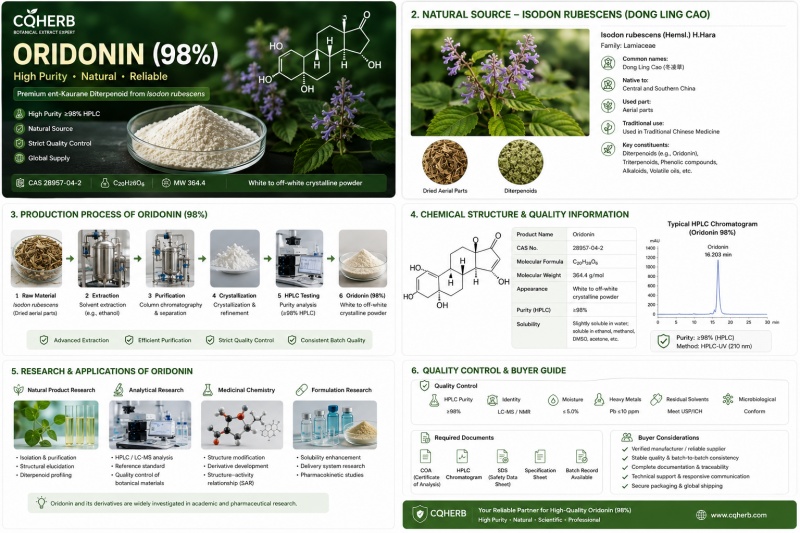
        Oridonin (98%) Ultimate Guide A Technical Guide to Structure, Natural Sources, Research, Production, Quality Control and Supplier Selection Oridonin is a naturally occurring diterpenoid isolated primarily from Isodon rubescens, a plant traditionally known in China as Dong Ling Cao. It has attracted substantial scientific interest because of its distinctive ent-kaurane-type molecular framework, diverse natural-product chemistry, and extensive research across molecular biology, pharmacology, pharmaceutical chemistry, and drug-discovery research. For manufacturers and research organizations, however, understanding Oridonin requires more than reviewing its reported biological activities. The quality of a commercial Oridonin material depends on its botanical source, extraction and purification process, analytical methodology, purity specification, batch consistency, and supporting technical documentation. This guide provides a research-oriented overview of Oridonin, with particular attention to high-purity 98% Oridonin, including its chemical identity, natural source, physicochemical characteristics, production considerations, analytical quality control, research applications, and practical supplier evaluation.     Quick Answer What Is Oridonin? Oridonin is a naturally occurring ent-kaurane-type diterpenoid primarily associated with Isodon rubescens, a member of the Lamiaceae family. Its CAS number is 28957-04-2, molecular formula is C20H28O6, and molecular weight is approximately 364.4 g/mol. Oridonin is one of the most extensively studied diterpenoids found in Isodon rubescens. Modern research has investigated its molecular interactions, cellular pathways, pharmacokinetic characteristics, structural modifications, and potential applications in natural-product and pharmaceutical research. From a commercial perspective, high-purity Oridonin is different from a conventional Isodon rubescens or Dong Ling Cao extract. A standardized botanical extract contains multiple naturally occurring constituents, whereas 98% Oridonin is a purified single compound with a defined molecular identity and a much narrower analytical specification. This distinction makes high-purity Oridonin particularly relevant to laboratories and manufacturers that require reproducible research materials, defined chemical composition, and quantitative analytical control. For buyers, evaluating Oridonin quality should therefore go beyond the stated purity. Important considerations include HPLC methodology, chromatographic profile, identity confirmation, residual solvents, heavy metals, moisture, storage conditions, batch consistency, and the supplier's ability to provide complete technical documentation.     Key Takeaways Oridonin is a naturally occurring diterpenoid primarily associated with Isodon rubescens. CAS 28957-04-2 is the commonly recognized CAS identifier for Oridonin. Its molecular formula is C20H28O6, with a molecular weight of approximately 364.4 g/mol. Kew's Plants of the World Online currently accepts Isodon rubescens as the species name, while Rabdosia rubescens is treated as a synonym. Oridonin belongs to the ent-kaurane diterpenoid family. Isodon rubescens contains numerous diterpenoids and other secondary metabolites, with Oridonin among its best-studied constituents. High-purity Oridonin and Isodon rubescens extract are not interchangeable products. HPLC is an important analytical tool for evaluating Oridonin purity and the quality of Isodon rubescens-derived materials. Research on Oridonin includes natural-product chemistry, molecular mechanisms, pharmacokinetics, structural modification, and drug-discovery studies. Its relatively limited aqueous solubility and bioavailability remain important considerations in pharmaceutical research. For B2B procurement, purity should be evaluated together with identity, analytical methodology, documentation, and batch consistency.     Table of Contents What Is Oridonin? Why Is Oridonin Scientifically Important? Oridonin Chemical Structure and Properties Natural Source: Isodon rubescens Oridonin vs. Isodon rubescens Extract How Is High-Purity Oridonin Produced? Oridonin Quality Standards and HPLC Analysis Oridonin Solubility and Stability Considerations Research Applications of Oridonin Oridonin Derivatives and Structural Modification How to Choose a Reliable Oridonin Supplier Buyer Checklist for Oridonin 98% Frequently Asked Questions CQHERB Technical Insight Scientific References     1. What Is Oridonin? Oridonin is a naturally occurring diterpenoid found primarily in Isodon rubescens. It belongs to a structurally diverse family of plant-derived diterpenes and is characterized as an ent-kaurane-type diterpenoid. The compound has been extensively investigated because of its distinctive polycyclic molecular framework and multiple oxygen-containing functional groups. These structural characteristics make Oridonin an important subject in natural-product chemistry and medicinal chemistry research. The accepted botanical name is currently Isodon rubescens (Hemsl.) H.Hara, according to the Royal Botanic Gardens, Kew. Rabdosia rubescens is treated by Kew as a synonym. Both names therefore appear frequently in scientific publications and commercial literature. Definition Oridonin is a naturally occurring ent-kaurane diterpenoid with the molecular formula C20H28O6 and CAS 28957-04-2, primarily isolated from Isodon rubescens.     2. Why Is Oridonin Scientifically Important? Oridonin has attracted sustained scientific attention for several reasons. First, it represents a structurally distinctive natural-product scaffold. Second, it can be isolated and purified as a chemically defined compound, allowing researchers to investigate its molecular properties independently of the many other constituents found in the plant. Third, a substantial body of research has investigated Oridonin in cellular, biochemical, pharmacokinetic, and medicinal-chemistry contexts. Reviews published in recent years have summarized research involving signaling pathways, cell-cycle regulation, apoptosis, autophagy, oxidative processes, and other molecular phenomena. Importantly, much of this literature concerns preclinical or experimental research. Findings from cell models or animal studies should not automatically be interpreted as evidence of established clinical efficacy in humans. This distinction is particularly important when presenting Oridonin on a commercial website.     Why Does High-Purity Oridonin Matter? Research reproducibility is strongly influenced by material consistency. A crude botanical extract can contain numerous compounds whose concentrations vary according to: Plant origin Cultivar or genetic background Growing conditions Harvesting period Extraction method Processing conditions Storage A purified Oridonin material reduces many of these variables by providing a defined target compound. For laboratory and formulation-development work, high-purity Oridonin can therefore offer: Defined chemical identity Standardized purity Better batch-to-batch consistency More reproducible analytical results Easier comparison between experiments More precise formulation calculations     Scientific Research Timeline Research Stage General Development Early natural-product research Isolation and structural characterization of Oridonin Later phytochemical research Expansion of research on Isodon diterpenoids Modern analytical research Improved HPLC and LC-MS characterization Molecular research era Increasing investigation of cellular and signaling mechanisms Recent research Structural modification, delivery systems, pharmacokinetics, and drug-discovery studies The continuing development of analytical and biochemical technologies has allowed researchers to investigate Oridonin at increasingly detailed molecular levels. Section Summary Oridonin is scientifically important not simply because it originates from a traditional medicinal plant, but because it combines a distinctive natural-product structure with extensive experimental research and the ability to be isolated as a defined compound.     3. Oridonin Chemical Structure and Physicochemical Properties Basic Chemical Information Property Information Common Name Oridonin CAS Number 28957-04-2 Molecular Formula C20H28O6 Molecular Weight 364.4 g/mol Chemical Class ent-Kaurane diterpenoid Natural Source Isodon rubescens Typical High-Purity Specification ≥98% by HPLC The molecular identity and basic chemical information are consistent with the PubChem record for Oridonin.     What Makes the Oridonin Structure Interesting? Oridonin possesses a complex tetracyclic diterpenoid framework containing several oxygenated functional groups and an enone-related structural motif. This combination of structural features contributes to the compound's importance in medicinal-chemistry research. Researchers have also used the Oridonin scaffold as a starting point for chemical modification. Various derivatives have been investigated with the goal of modifying properties such as solubility, stability, pharmacokinetics, and biological activity.     Key Definitions DiterpenoidA natural product generally derived from four isoprene units and containing 20 carbon atoms. ent-Kaurane diterpenoidA structural class of diterpenoids characterized by a specific tetracyclic carbon skeleton. HPLCHigh-Performance Liquid Chromatography, an analytical technique commonly used to separate, identify, and quantify components in a sample. PurityThe proportion of the target compound relative to other detectable components under a defined analytical method.     Section Summary Oridonin's defined molecular formula and distinctive ent-kaurane diterpenoid structure make it suitable for detailed analytical and medicinal-chemistry research. Its structural framework has also become a useful starting point for investigating chemically modified derivatives.     4. Natural Source: Isodon rubescens What Plant Produces Oridonin? The principal natural source associated with Oridonin is Isodon rubescens (Hemsl.) H.Hara, a species in the Lamiaceae family. Kew currently recognizes Isodon rubescens as the accepted name and lists Rabdosia rubescens as a synonym. The species is native to central and southern China. The plant is commonly known in Chinese contexts as Dong Ling Cao (冬凌草), and the dried aerial parts have a long history of use in traditional Chinese medicine.     Phytochemical Complexity of Isodon rubescens One important point for buyers is that Isodon rubescens is not an Oridonin-only plant. Scientific reviews have documented a large number of secondary metabolites from the species, including: Diterpenoids Triterpenoids Phenolic compounds Alkaloids Volatile constituents Other specialized metabolites Among these constituents, diterpenoids represent one of the most extensively studied groups, with Oridonin being one of the best-known compounds.     Why Botanical Source Matters The concentration of individual compounds in a botanical raw material can vary according to: Plant genetics Geographic origin Cultivation conditions Harvest time Plant part Drying conditions Extraction technology Research on Rabdosia rubescens has also demonstrated that the contents of several compounds can vary among different cultivars, reinforcing the importance of analytical quality control. Section Summary Isodon rubescens is the principal botanical source associated with Oridonin. Because the plant contains a complex mixture of diterpenoids and other secondary metabolites, high-purity Oridonin requires dedicated extraction and purification rather than simple botanical extraction.     5. Oridonin vs. Isodon rubescens Extract This distinction is particularly important for international buyers. Feature Oridonin 98% Isodon rubescens Extract Product Type Purified single compound Multi-component botanical extract Main Target Oridonin Multiple plant constituents Purity Specification Typically expressed as Oridonin % by HPLC May use extract ratio or marker-compound specification Chemical Composition Narrowly defined Complex Research Reproducibility High when analytical method is controlled Dependent on extract specification Typical Use Research, analytical and formulation development Botanical ingredient research and formulation Quality Control HPLC, identity, impurities and other specifications Marker compounds, extraction ratio, contaminants and other specifications Buyer Tip If a project requires a defined concentration of Oridonin, purchasing a standardized high-purity Oridonin material is generally more straightforward than relying on a conventional Isodon rubescens extract. If the project specifically requires the broader phytochemical profile of the plant, a standardized botanical extract may be more appropriate. Section Summary Oridonin 98% and Isodon rubescens extract should not be treated as equivalent products. The former is a purified compound; the latter is a complex botanical preparation with multiple constituents.     6. How Is High-Purity Oridonin Produced? From Botanical Raw Material to Purified Compound The production of high-purity Oridonin requires several stages because the target compound occurs together with numerous other constituents in the plant. A simplified production concept is: Botanical Raw Material ↓ Extraction ↓ Filtration / Concentration ↓ Fractionation ↓ Purification ↓ Crystallization or Further Refinement ↓ Drying ↓ HPLC Testing ↓ High-Purity Oridonin The exact process depends on the manufacturer's technology, raw material specification, target purity, scale, and analytical requirements.     Extraction The first objective is to transfer Oridonin and related constituents from the plant matrix into an appropriate extract. Extraction parameters may influence: Yield Impurity profile Solvent consumption Downstream purification requirements     Purification Crude extracts contain many naturally occurring compounds. Therefore, achieving a high Oridonin specification requires selective separation from: Other diterpenoids Pigments Phenolic constituents Lipophilic components Other plant-derived impurities Published research has demonstrated the use of chromatographic technologies such as high-speed counter-current chromatography for the isolation and purification of Oridonin from Isodon rubescens.     HPLC Verification Following purification, analytical testing is used to determine whether the material meets the required specification. HPLC can provide information about: Retention time   Target peak Relative purity Chromatographic profile Potential impurities Research has also developed HPLC-based methods for simultaneous characterization and quantification of multiple compounds in Rabdosia rubescens, highlighting the importance of chromatographic analysis in quality control.     CQHERB Technical Insight For high-purity botanical monomers, the manufacturing challenge is not simply "extracting more compound." The key challenge is achieving selective purification while maintaining reproducible analytical quality. This is why a professional supplier should be able to explain not only the final purity but also the analytical method used to verify that specification.     7. Oridonin Quality Standards and HPLC Analysis Is 98% Purity Enough? Not necessarily. A 98% purity statement is useful, but it should be interpreted together with the analytical method and supporting documentation. When evaluating an Oridonin 98% material, buyers should review: 1. HPLC Purity Confirm how the 98% value was determined. Questions may include: Which HPLC method was used? Is the method clearly described? Is the chromatogram available? Is the purity calculated by area normalization or another method? 2. Identity The supplier should be able to demonstrate that the tested compound is Oridonin rather than another diterpenoid with a similar chromatographic behavior. 3. Chromatographic Profile A chromatogram can provide useful information about: Main peak Retention time Secondary peaks Overall sample profile 4. Residual Solvents If organic solvents are used during manufacturing, residual solvent testing may be appropriate depending on the intended application and applicable standards. 5. Heavy Metals and Contaminants For botanical-derived materials, buyers may also request information concerning: Lead Cadmium Arsenic Mercury Microbiological parameters     Recommended Technical Documents For international B2B procurement, a professional supplier should be prepared to provide, where applicable: Certificate of Analysis (COA) Product Specification HPLC Chromatogram SDS / MSDS Technical Data Sheet Residual Solvent Information Heavy Metal Information Packaging Information Storage Recommendations     8. Oridonin Solubility and Stability Considerations Solubility is an important technical issue when working with Oridonin. Published research has identified relatively limited aqueous solubility and bioavailability as important challenges in the development of Oridonin-based pharmaceutical formulations. Researchers have investigated approaches including structural modification, formulation technologies, nanoparticles, liposomes, and co-crystals to address these limitations. For research and formulation developers, this means that Oridonin should not be evaluated only according to chemical purity. Practical considerations can include: Solvent selection Concentration Temperature Storage conditions Light exposure Container compatibility Formulation matrix     Why Solubility Matters in Research Two samples with identical HPLC purity can behave differently in a practical formulation if: Particle size differs Sample preparation differs Solvent systems differ Storage history differs Experimental temperature differs Therefore, research protocols should clearly document sample preparation conditions when Oridonin is used in solution-based experiments. Section Summary Oridonin's physicochemical characteristics, particularly its limited aqueous solubility, are important considerations for research and formulation development. High chemical purity does not automatically guarantee easy formulation or high bioavailability.     9. Research Applications of Oridonin Oridonin has been investigated across several areas of scientific research. Natural Product Chemistry Researchers study Oridonin as a representative ent-kaurane diterpenoid and as one component of the complex phytochemistry of Isodon rubescens. Research topics include: Isolation Structural elucidation Derivatization Analytical characterization Natural-product biosynthesis     Molecular and Cellular Research A large body of experimental literature has examined Oridonin in relation to cellular processes such as: Apoptosis Autophagy Cell-cycle regulation Oxidative stress Inflammatory signaling Cellular metabolism These findings are predominantly based on laboratory and preclinical models and should not be interpreted as proof of clinical efficacy. Recent reviews continue to examine Oridonin's proposed molecular mechanisms and its interaction with multiple signaling pathways.     Pharmaceutical Chemistry Research Oridonin has also become a useful starting scaffold for medicinal-chemistry research. Researchers have explored structural modifications designed to address challenges such as: Poor aqueous solubility Limited bioavailability Rapid clearance Pharmacokinetic limitations Oridonin derivatives have therefore become a separate research area within natural-product drug discovery.     Analytical Research Because Oridonin is a defined chemical compound, it can also be used in: HPLC method development LC-MS analysis Reference-material research Botanical quality-control studies Comparative phytochemical analysis   Important Research Disclaimer The biological activities described in scientific literature do not mean that Oridonin 98% sold as a research ingredient is an approved pharmaceutical or that it is intended to diagnose, treat, cure, or prevent disease. Research findings should always be interpreted according to the experimental model, concentration, formulation, and study design.     10. Oridonin Derivatives and Structural Modification One particularly interesting aspect of Oridonin research is the development of chemically modified derivatives. The natural Oridonin scaffold has been used as a starting point for exploring changes to functional groups and molecular regions that may affect: Solubility Stability Target interaction Pharmacokinetics Biological activity Reviews of Oridonin derivatives have documented extensive medicinal-chemistry research aimed at improving properties of the parent compound. This research demonstrates an important principle in natural-product chemistry: A natural compound can serve not only as a research material itself, but also as a structural template for the development of new chemical entities. Section Summary Oridonin continues to attract interest as both a natural compound and a chemical scaffold. Research on its derivatives illustrates the intersection between botanical chemistry, medicinal chemistry, and modern drug-discovery research.     11. How to Choose a Reliable Oridonin Supplier For B2B buyers, selecting an Oridonin supplier should involve more than comparing prices. 1. Confirm Product Identity Check: CAS number Chemical name Molecular formula Molecular weight HPLC profile 2. Confirm Purity Method Ask how the 98% specification is determined and request the corresponding analytical documentation. 3. Review Batch Documentation A current-batch COA is more useful than a generic specification sheet. 4. Evaluate Manufacturing Capability Understand whether the supplier: Manufactures the material Controls purification Performs analytical testing Maintains batch records 5. Evaluate Technical Support For research-grade ingredients, technical communication can be as important as price. A reliable supplier should be able to answer questions about Purity HPLC Solubility Storage Packaging Lead time Documentation     12. Buyer Checklist for Oridonin 98% Before placing an order, buyers can use the following checklist. Confirm CAS 28957-04-2 Confirm molecular formula C20H28O6 Confirm molecular weight Confirm ≥98% HPLC specification Request current-batch COA Request HPLC chromatogram Confirm identity-testing method Review residual solvent information Review heavy-metal information Confirm packaging Confirm storage conditions Confirm sample availability Confirm production lead time Confirm technical documentation Evaluate long-term supply capability     13. Frequently Asked Questions What is Oridonin? Oridonin is a naturally occurring ent-kaurane diterpenoid primarily associated with Isodon rubescens. Its CAS number is 28957-04-2. What is the CAS number of Oridonin? The commonly recognized CAS number is 28957-04-2. What is the molecular formula of Oridonin? The molecular formula is C20H28O6. What is the molecular weight of Oridonin? The molecular weight is approximately 364.4 g/mol. What plant does Oridonin come from? Oridonin is primarily associated with Isodon rubescens, a species in the Lamiaceae family. Rabdosia rubescens is a recognized synonym. Is Oridonin the same as Dong Ling Cao extract? No. Dong Ling Cao or Isodon rubescens extract is a complex botanical preparation, while Oridonin is a purified individual compound. What does 98% Oridonin mean? It generally indicates that Oridonin constitutes at least approximately 98% of the material according to the stated analytical method, commonly HPLC. The analytical method should always be reviewed alongside the stated purity. How is Oridonin purity tested? HPLC is commonly used for quantitative analysis and purity assessment. Additional techniques such as LC-MS or NMR can be used for identity characterization depending on the application. Is Oridonin water soluble? Oridonin has limited aqueous solubility, which has been identified as an important technical challenge in pharmaceutical formulation research. What is Oridonin used for? High-purity Oridonin is primarily relevant to scientific research, natural-product chemistry, analytical studies, pharmaceutical chemistry, and formulation-development research. Is Oridonin an approved drug? Research into Oridonin and Oridonin derivatives is ongoing, but a research-grade Oridonin ingredient should not be represented as an approved pharmaceutical merely because pharmacological studies have been published. What is the difference between Oridonin and other Isodon diterpenoids? Isodon rubescens contains numerous diterpenoids. Oridonin is one specific compound with its own chemical identity, molecular formula, and analytical profile. Can Oridonin be used as an analytical reference material? High-purity Oridonin can be relevant to analytical research, but suitability as a formal reference standard depends on the required certification, purity characterization, intended analytical method, and applicable standards. Why is HPLC important for Oridonin? HPLC provides a practical way to separate and quantify Oridonin and assess the chromatographic profile of a sample. What documents should an Oridonin supplier provide? Typical documents may include COA, specification sheet, HPLC chromatogram, SDS/MSDS, and technical data. Additional documents depend on the customer's application and regulatory requirements. How should Oridonin be stored? Storage recommendations should follow the supplier's validated specification and stability information. In general, minimizing unnecessary exposure to heat, moisture, and light is a prudent approach for purified natural products. Can Oridonin derivatives be synthesized? Yes. Numerous research programs have investigated structural modification of Oridonin to explore changes in physicochemical and biological properties. Why do researchers study Oridonin derivatives? One major reason is to investigate whether structural modification can address limitations of the parent compound, including solubility and pharmacokinetic characteristics. What should buyers check before purchasing Oridonin 98%? The most important items include identity, HPLC purity, chromatogram, COA, production source, analytical method, contaminants, storage conditions, and supplier consistency. Is Oridonin 98% the same as a 98% Isodon rubescens extract? No. "98% Oridonin" describes a purified compound specification, whereas "98% Isodon rubescens extract" would describe a very different product concept and should not be assumed to have the same chemical composition.     14. CQHERB Technical Insight Purity Is Only One Part of Botanical Monomer Quality For high-purity botanical compounds such as Oridonin, it is tempting to evaluate suppliers based solely on the number printed on the COA. However, professional procurement requires a broader view. A robust quality assessment should consider: Identity Is the material actually Oridonin? Purity Does the material meet the stated ≥98% specification? Analytical Method How was the purity determined? Chromatographic Profile Does the HPLC chromatogram demonstrate a clean and consistent profile? Contaminant Control Are residual solvents, heavy metals, moisture, and microbiological parameters appropriately controlled? Batch Consistency Can the supplier provide the same specification repeatedly? Traceability Can the material be traced to a defined manufacturing and testing process? This approach is particularly important when Oridonin is used in research projects where reproducibility is more important than simply achieving the lowest purchase price.     15. Industry Insight The development of Oridonin reflects a broader trend in the botanical ingredient industry: the transition from complex traditional extracts toward well-characterized natural compounds. Researchers and manufacturers increasingly require: Defined molecular identity Standardized purity Reliable analytical data Consistent batch quality Transparent technical documentation At the same time, advances in natural-product chemistry are creating new opportunities for studying botanical compounds as molecular scaffolds rather than simply as traditional herbal extracts. Oridonin is a particularly useful example of this transition because research has expanded from simple isolation and characterization to molecular mechanisms, pharmacokinetics, structural modification, delivery technologies, and derivative development.     Why We Published This Guide The purpose of this guide is not to promote Oridonin through unsupported efficacy claims. Instead, CQHERB aims to provide researchers, manufacturers, and purchasing professionals with a practical technical reference for understanding: What Oridonin is Where it comes from How it differs from botanical extracts How high-purity material is evaluated Why HPLC matters What technical challenges researchers should consider How to evaluate suppliers For botanical ingredients, reliable information is an essential part of product quality.     Final Summary Oridonin is a structurally distinctive ent-kaurane diterpenoid primarily associated with Isodon rubescens. With a molecular formula of C20H28O6 and CAS 28957-04-2, it has become one of the most extensively studied diterpenoids from this botanical source. Modern research extends from natural-product isolation and structural characterization to molecular biology, pharmacokinetics, formulation science, and the development of Oridonin derivatives. At the same time, researchers continue to investigate challenges such as limited aqueous solubility and bioavailability. For B2B buyers, the key consideration is that 98% Oridonin is a purified single compound rather than a conventional Isodon rubescens extract. Its quality should therefore be evaluated through a combination of purity, identity, HPLC profile, contaminant control, documentation, and batch consistency. As scientific interest in standardized natural compounds continues to expand, Oridonin represents an important example of how traditional botanical resources can become well-characterized materials for modern natural-product and pharmaceutical research.     Looking for a Reliable Oridonin Supplier? If you are sourcing high-purity Oridonin (98%) for research, analytical development, formulation studies, or long-term B2B supply, technical specifications should be evaluated according to your intended application. CQHERB can provide product information and technical documentation for evaluation, including: COA Product Specification HPLC Chromatogram SDS/MSDS Technical Data Sample Support Packaging Information Request Technical Information     Scientific References PubChem. Oridonin – CID 5321010. National Center for Biotechnology Information. Royal Botanic Gardens, Kew. Plants of the World Online: Isodon rubescens (Hemsl.) H.Hara. Royal Botanic Gardens, Kew. Rabdosia rubescens (Hemsl.) H.Hara – synonym of Isodon rubescens. Ali MA, et al. Oridonin from Rabdosia rubescens: An emerging potential in cancer therapy – A comprehensive review. Food Science & Nutrition. 2024. Zhang Y, Wang S, Dai M, et al. Solubility and Bioavailability Enhancement of Oridonin: A Review. Molecules. 2020;25(2):332. Oridonin: A Review of Its Pharmacology, Pharmacokinetics and Toxicity. PubMed-indexed review. Sobral PJM, Vicente ATS, Salvador JAR. Recent advances in oridonin derivatives with anticancer activity. Frontiers in Chemistry. 2023. The Natural Product Oridonin as an Anticancer Agent: Current Achievements and Problems. PubMed-indexed review. 2023. Isolation and Purification of Oridonin from the Whole Plant of Isodon rubescens by High-Speed Counter-Current Chromatography. Simultaneous characterization and quantification of 17 main compounds in Rabdosia rubescens by high performance liquid chromatography. PubMed. Recent Advances on the Molecular Mechanisms of Apoptosis Induced by Natural Product Oridonin and Its Derivatives. 2026 review. Anticancer mechanisms on pyroptosis induced by Oridonin: New potential targeted therapeutic strategies. Biomedicine & Pharmacotherapy. 2023.   The bioavailability enhancement and insight into the action mechanism of poorly soluble natural compounds from co-crystals preparation: Oridonin as an example. Phytomedicine. 2024. Discovery and development of natural product oridonin-inspired anticancer agents. PubMed-indexed review. Research progress and molecular mechanism of oridonin in the treatment of malignant melanoma. 2025 review.     Content Classification Content Type: Ultimate Guide / Pillar PageKnowledge Base Category: Botanical Extract Knowledge BasePrimary Search Intent: Informational + Commercial InvestigationTarget Audience: Researchers, formulators, manufacturers, procurement professionals and ingredient buyersRecommended Content Cluster: Oridonin Ultimate Guide↓What Is Oridonin?↓Oridonin Chemical Structure↓Oridonin Solubility & Stability↓Oridonin HPLC & COA Guide↓Oridonin Extraction & Purification↓Oridonin vs. Isodon rubescens Extract↓How to Choose an Oridonin Supplier↓Oridonin FAQ Hub     Important Editorial Note This article intentionally distinguishes scientific research findings from established clinical or commercial claims. Oridonin has been extensively investigated in experimental systems, but published preclinical findings should not be presented as proof of human therapeutic efficacy. This positioning helps maintain the professional, research-oriented character of the CQHERB Knowledge Base and reduces unnecessary regulatory and advertising risk.
    阅读更多

留言

留言
如果您对我们的产品感兴趣并想了解更多详情,请在此留言,我们会尽快回复您。
提交

主页

产品

Whatsapp

接触